


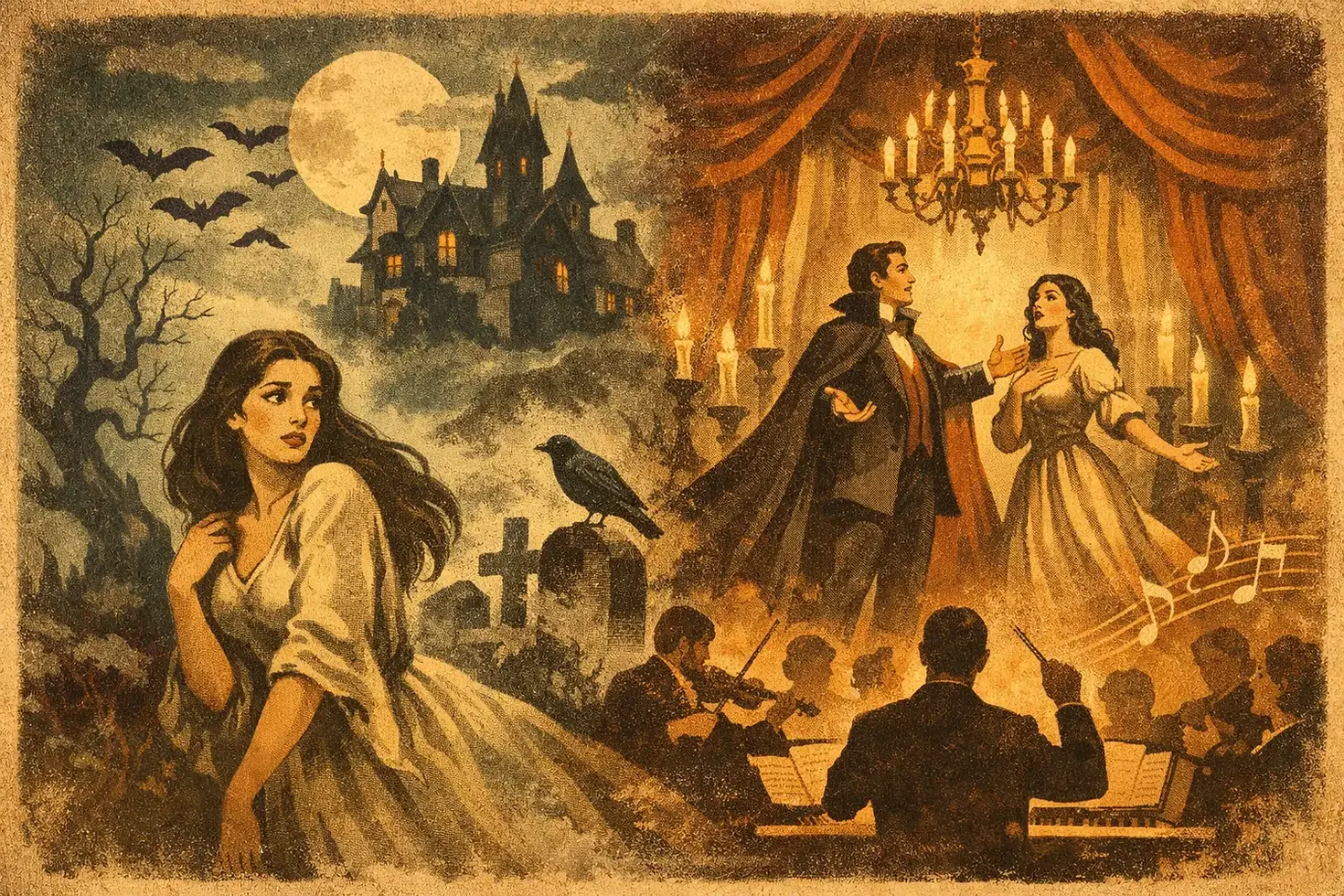
How Gothic Novels Become Musicals

A locked room, a ruined reputation, a whispered confession by candlelight - this is where the theatre begins. If you have ever wondered how gothic novels become musicals, the answer is not by softening their shadows. It happens by giving those shadows a voice, a rhythm, and, at the right moment, a melody so charged with feeling that silence would no longer do.
Gothic fiction already lives close to performance. It thrives on entrances, secrets, mirrors, letters, storms, portraits, corridors, and the dangerous split between what is shown and what is hidden. A stage musical, at its best, does much the same. The challenge is not whether the form can contain gothic material. The challenge is whether it can preserve the novel’s menace, beauty, and moral consequence while making the story immediate for a live audience.
Why how gothic novels become musicals feels natural
A gothic novel is rarely small in feeling. Even when the action is intimate, the emotional scale is enormous. Desire becomes obsession. Beauty curdles into corruption. A private sin can poison an entire house. That heightened emotional world suits music remarkably well.
Songs allow a musical to externalise what a novel may keep hidden in prose. In fiction, a character’s dread can unfold over pages of interior reflection. On stage, that same dread must be grasped in an instant. Music solves part of that problem. It gives shape to temptation, panic, vanity, grief, and hunger. A sustained note can express what a line of dialogue cannot quite hold.
That does not mean every gothic novel should sing. Some depend so heavily on narrative ambiguity or psychological distance that a musical adaptation may pin down too much. The form works best when the source contains strong emotional conflicts, vivid imagery, and a central tension that can be dramatised in scenes as well as songs.
The first transformation is structural
The novel and the stage do not breathe at the same pace. A novel can linger. It can circle an idea, delay an answer, and dwell in atmosphere for chapters. A musical has to move with purpose. Even a lavish, haunting production cannot stop the story dead for the sake of literary reverie.
That is why adaptation begins with ruthless clarity. What is the core dramatic line? Whose downfall, awakening, bargain, or pursuit drives the evening? Which relationships carry the heat? Once those questions are answered, whole passages of the novel may fall away, not because they lack merit, but because theatre requires concentration.
A gothic adaptation usually succeeds when it identifies the story’s central seduction. In one tale, that may be immortality. In another, forbidden love, social ruin, revenge, or the fear of inheritance. The musical must know which danger is pulling every scene towards its inevitable cost.
Subplots often shrink. Narration becomes action. Description becomes design. A diary entry may become a duet. A chapter of creeping suspicion may become a sequence in which lighting, underscoring, and movement tell the audience that something is terribly wrong before a word confirms it.
How gothic novels become musicals without losing their darkness
The greatest risk in adaptation is not change. It is dilution. A gothic novel cannot be turned into a satisfying musical by sanding off its cruelty and calling the result accessible. Audiences come to gothic stories for danger. They want beauty, certainly, but beauty with teeth.
That means the adaptation must protect the original stakes. If the novel is about moral decay, the musical cannot pretend the damage is decorative. If the story rests on corruption beneath elegance, then the score, performances, and staging must all serve that contrast. The prettiest melody in the evening may need to carry the ugliest truth.
This is where tone becomes everything. Gothic musicals fail when they lapse into camp without control or solemnity without pulse. They work when they understand that wit and terror can coexist, and that glamour is often most potent when it masks rot. Oscar Wilde, Bram Stoker, Charlotte Brontë, Daphne du Maurier - each in a different register - understood that civilised surfaces can conceal monstrous appetites. A stage version must understand it too.
Music does the work prose once did
In a novel, atmosphere is built through language. On stage, atmosphere is made collectively. The score carries a remarkable share of that burden.
A gothic score tends to rely on recurrence and transformation. A theme introduced as seductive may return later as accusatory. A love melody may reappear fractured, drained of innocence. Harmony can suggest instability long before the plot reaches its crisis. Even silence, placed after a swelling musical moment, can feel like a threat.
Lyrics have a different task. They cannot simply paraphrase the book. If they do, they become dutiful and lifeless. Instead, they should distil emotional truth. A character need not explain every thought the novel provides. They need to sing the thought that burns hottest.
This is especially important with morally divided protagonists. Gothic fiction is full of characters who conceal, split, repress, perform, and deceive. Music lets the audience hear the conflict under the mask. A charming public figure can sing one thing and be haunted by another. A villain can become more frightening, not less, when given language fine enough to make corruption sound almost reasonable.
Design turns metaphor into something visible
Gothic novels are rich in symbols: portraits, staircases, locked doors, roses, blood, glass, fog, firelight. On stage, these images cannot simply be mentioned. They must be embodied.
That does not always require naturalism. In fact, too much literal realism can make a gothic musical feel smaller. Suggestion is often more powerful. A portrait need not merely hang on a wall; it can dominate the visual grammar of the production. A corridor can lengthen through light and perspective. A ballroom can become a trap if the choreography tightens instead of opening.
Costume is no minor matter either. In gothic storytelling, clothing often reveals status, control, vanity, repression, and desire. The silhouette of a figure entering under low light can tell the audience whether they are meeting innocence, authority, decadence, or doom.
The finest productions understand that design is not background decoration. It is storytelling. In a piece such as Dorian Gray The Musical, the visual world must carry elegance and corruption at once, or the evening loses its pulse.
Performance style matters more than people think
Not every strong musical performer is right for gothic material. The genre demands scale, certainly, but not carelessness. It needs actors who can sustain heightened language without sounding false and singers who can deliver emotional extremity without flattening it into melodrama.
There is a delicate balance here. Gothic performance must be bold enough to fill the theatre and precise enough to preserve tension. Too restrained, and the story feels bloodless. Too broad, and the danger starts to feel safe.
This is one reason classic novels can find such vivid new life on stage. When the casting is right, familiar characters cease to be museum pieces. They become urgent, volatile, and perilously human in front of us. A choice made in real time under stage light has a different charge from one read in solitude.
Fidelity is not the same as literalness
Audiences who love classic literature often ask whether an adaptation is faithful. It is a fair question, but a slippery one. Faithfulness does not mean preserving every scene or line. It means preserving the spirit, argument, and emotional architecture of the original work.
A musical may reorder events, combine minor characters, or sharpen a romance that was more oblique on the page. Those changes can be entirely justified if they clarify the central tragedy rather than distort it. The test is simple: does the adaptation still feel like the same moral universe? Do the consequences still land where they should?
When a gothic adaptation honours the source properly, it does not embalm it. It reanimates it. That is the thrill. A novel written in another century can suddenly feel immediate, dangerous, and achingly present.
Why audiences keep returning to these stories
Part of the appeal is obvious. Gothic tales offer passion, scandal, atmosphere, and unforgettable imagery. Yet their endurance runs deeper than style. They ask questions that never become quaint: What is beauty worth? What does desire cost? Can a hidden life stay hidden? What happens when pleasure outruns conscience?
A musical intensifies those questions because it places them before a crowd. The audience does not merely witness the descent. It feels it collectively - in breath, in sound, in the moment after a final note when the whole theatre seems to hold its nerve.
That is ultimately how gothic novels become musicals. Not through ornament, and not through novelty for its own sake, but through a disciplined act of translation. The novel offers dread, longing, elegance, and ruin. The stage answers with voice, image, movement, and music. When those forces are aligned, the result is not a compromise between literature and entertainment. It is a dark bargain of its own, and a glorious one to witness live.
If a gothic story has ever unsettled you on the page, it may move you even more in the theatre, where temptation can sing and consequence arrives in full view.


Comments